
The Attention Economy Has a Supply Chain Problem
TL;DR
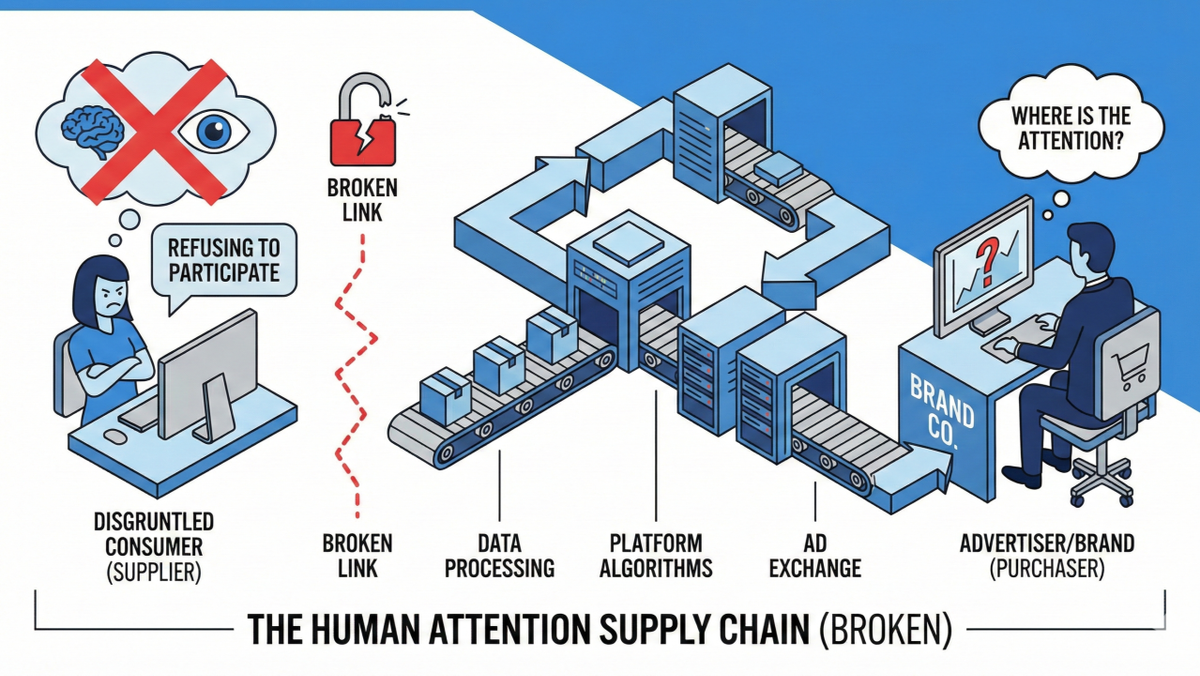
Human attention is a real marketplace. Consumers supply the product. Closed systems sell inventory they never bought and cut the supplier out of the deal. Treat attention like a commodity with ownership, measurement, and compensation that runs back to the source, and the market rebalances. That is the economics behind Personal Sponsorship and Sponster.
The metaphor is wrong
We talk about "the attention economy" as if it is a metaphor.
It is not. It is a marketplace, one of the largest on the planet, and like any marketplace it runs on suppliers, demand, distribution, pricing, and incentives.
But here is the strange thing about the market for human attention:
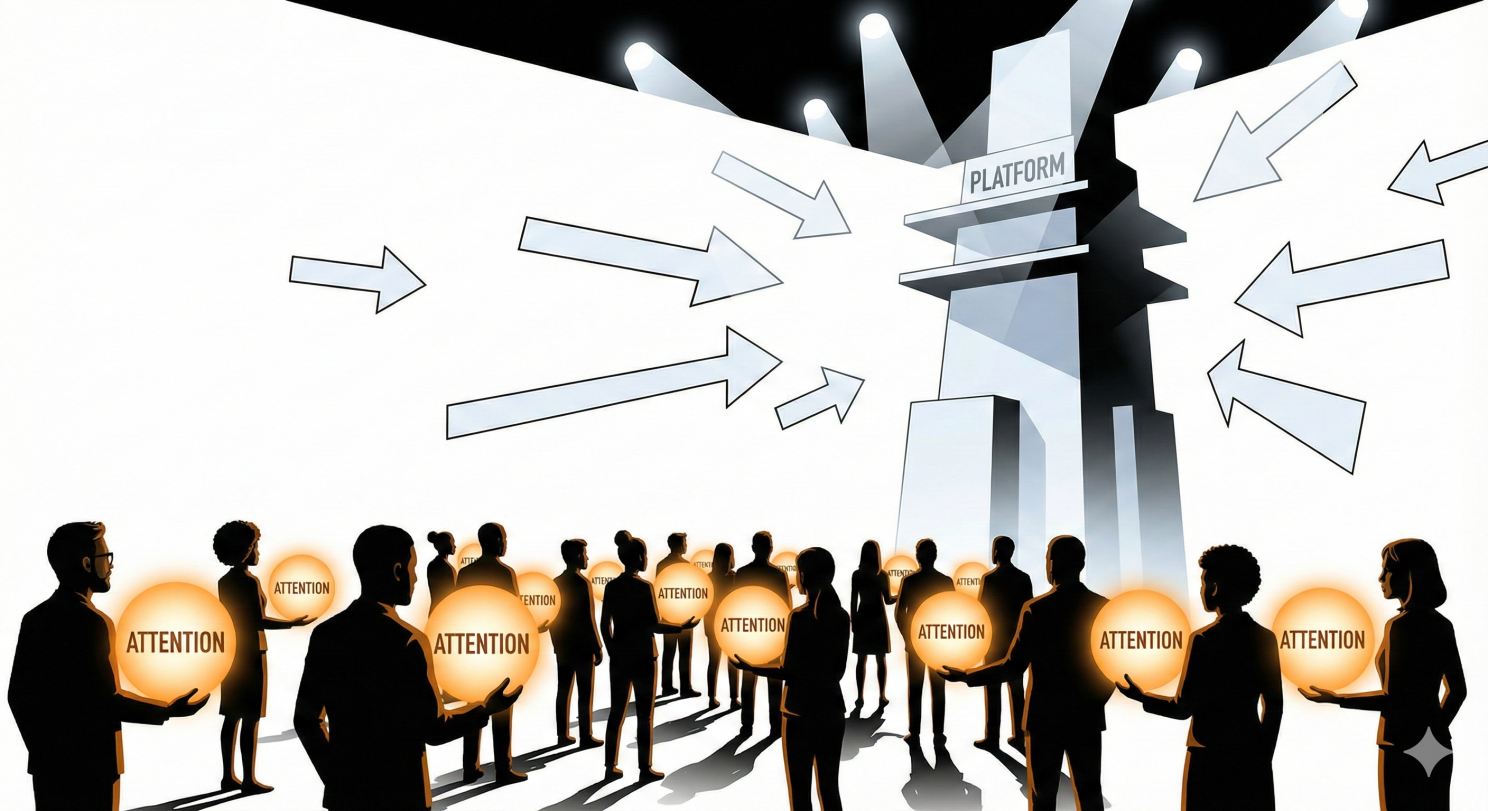
The people who supply the product are not recognized as suppliers.
The closed systems that distribute it behave like retailers who do not have to buy their inventory.
That would be unthinkable in any other industry. In advertising it became normal.
Here are the ordered thoughts that formed Qadabra's philosophy in building Sponster and the Personal Sponsorship category.
1. Attention is a real product and the true suppliers are unpaid
An easy 90% of the historic revenue of tech giants like Google and Meta comes from the sale of human attention. It powers everything else they do. It is not only a product. Its trade created some of the most monumental wealth in human history.
Every ad impression, click, view, and engagement is manufactured by a human being. Consumers are the real producers of the product: their time, focus, and cognitive bandwidth.
But the advertising supply chain treats this as a byproduct rather than a produced good.
That distortion creates textbook economic misalignment. The true supplier has no incentive to maintain or increase production.
As a result:
- Attention fragments
- Quality declines
- Ad blockers rise
- People tune out
- The supply of usable attention shrinks while the market pretends it is infinite
2. Closed systems sell inventory they never bought
Imagine a retailer who never pays for inventory, does not verify its quantity or quality, and still sells it at scale.
That is the modern advertising ecosystem.
Google, Meta, TikTok, and programmatic exchanges act as the "retailers" of attention, but unlike any legitimate supply chain they do not:
- Purchase inventory
- Source it
- Verify it
- Protect it
- Compensate the producer
Instead they simply declare an impression existed and sell it downstream.
Anywhere else this would be known as phantom inventory, a structural conflict of interest, and sometimes fraud.
This is how the industry ends up with fake views, bots, click farms, over-reported impressions, inflated CPMs, and 20–50% digital ad fraud.
No commodity market can function under these conditions indefinitely.
3. When suppliers are not paid, the whole market distorts
Because consumers are not recognized or compensated (incentivized) as suppliers, everything downstream contorts.
Consumers respond by opting out, scrolling faster, trusting less, blocking ads, and avoiding the ecosystem.
Advertisers respond by buying more volume, adding more tracking, increasing frequency, pushing more algorithms, and paying more for less.
That is equivalent to a factory squeezing suppliers to produce more without compensation simply because "demand is high."
It is economically unsustainable.
4. Two illusions now prop up the ad economy
Illusion 1: Infinite attention. Human attention is finite. Closed systems act as if it is limitless.
Illusion 2: Perfect attribution. They claim to know precisely which impression drove which outcome, but attribution is murky, error-prone, and easily gamed.
Illusions cannot support trillion-dollar industries forever.
5. Attention must be treated as a true commodity
Every mature commodity market eventually organizes around:
- Clear ownership
- Transparent measurement
- Trusted intermediaries
- Fair compensation for suppliers
- Direct relationships between producers and buyers
The attention market currently has none of these.
Macro forces are pushing in one inevitable direction: consumers will eventually be recognized and compensated as the actual owners and suppliers of attention.
Drivers include rising privacy laws, collapse of third-party tracking, advertisers demanding transparency, publishers needing new monetization, consumers wanting control of their data, and AI needing truthful, permissioned personal context.
The economics are forcing a new equilibrium.
6. The supply chain lens unlocks the entire argument
For years the conversation focused on cookies, targeting, tracking, privacy, and algorithms.
The real issue is not technology. It is economics.
The attention economy is dysfunctional because the supplier side of the market is missing.
Recognize attention as the product it is, and consumers as suppliers, and the system suddenly makes sense: markets become more transparent, publishers stabilize, advertisers waste less, consumers gain agency, and incentives finally align.
The takeaway
The marketplace for human attention is not exempt from economic laws. It is a supply chain. Right now it is one where the source of the product is unacknowledged, uncompensated, and increasingly unwilling to participate.
When consumers are finally recognized as suppliers, the market will rebalance.
And a trillion-dollar industry will operate like every healthy marketplace does: with incentives that run all the way back to the source of supply.
That is what Qadabra is building with Personal Sponsorship and Sponster: the open version of the attention marketplace, where the supplier is on the ticket.